March 2022
The Rossi Bar
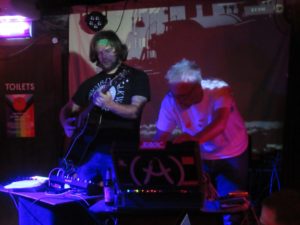
The first unheralded act of the evening was Ninit / Polysicness, who literally agreed to play 24 hours before he stepped on stage, the first of two COVID stand-ins. A background thrum of cassette distortion seems baked into the start of the set, the sound is thick, warm, enveloping in that nicely saturated manner that iron oxide gives you. Barging their way into this comes a murky rhythm and some drums, the wash of background sound dissolves and the sudden clarity makes your ears pick up. Greg is stopped over afar too low table, it looks painful. He suddenly off and wandering round the audience in the creepy see through mask giving delayed words to us. The music canters off a nice rumbling uneven bassline and rhythmic piano-ish stabs giving way to arpeggiated counterpoint. There is some serious pitch adjustment to lead lines giving things an odd eerie edge. A general mutation as we progress through the set, each part built on one piece from the previous. Rhythms change, drums grow lumpy or staccato, holding back the drive or suddenly lifting us forward. In the middle of the set there’s a pause where everything fleetingly disappears save a child’s voice, just enough to give us a bliss of tension before the release of everything coming back and we’re off again. As we move through the sound gradually thickens back up, the parts get noisier. As we approach the end everything gets louder, more muffled. Slows down. Speeds up. More shouting. Riffs revisit. That tape ambience is back. More bass drum. More reverb.

With slightly more notice, our first replacement, playing second, was Monty Oxymoron. Opening with a flurry of Morricone-esque guitarish notes off his keyboard, bouncing off the delay, a sound somewhere between guitar, space organ and electric piano Monty was running up and down the keyboard, twinkles of top end notes. Razor edged bass parts. Pausing and slowing down for more retrospective passages, before a proper shimmer of space sounds held us blissfully for a minute or so, segueing into a lovely passage of jazz tinged spaceness. He had a very plastic looking electric tambura that droned in somewhere around here, giving him the opportunity to go right out into the further reaches. Little melodic flourishes, scary bass lines, then off on another extended pianistic improvisation. Then we have a pause while he reads some passages from his book “The Cosmic Brain Explodes” over the tambura backing. Then a flurry of super-fast trebly Tangerine-ish arpeggios herald the return of the cosmic jazz. He does some odd stuff with timbre where he almost disappears into a black hole, before emerging again, pulsating and twinkling.
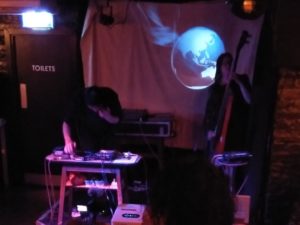
So finally and the only person who knew he’d be playing 6 weeks – or even a week previously we had Alien Alarms. Starting in a twinkling manner that flowed on quite nicely from Monty’s set, with a vocal sample from what sounded like a documentary on that new-fangled electronic music. The melodic parts float over a sparse bass line, that seems to go missing for bars at a time without losing anything, the drums are constantly evolving, this is where the real movement is, the dynamism. Without straying into Aphex style erraticism, they shift, add dynamics imperceptibly, drive us on. The second track carries on the bassline becoming more constant, dropping into massive long slurred tones at one point. Gradually the tempo shifts upwards, the third track takes the longer bass notes, not so much notes as a bar long pitch bent single note at times. Over this is a queasy 16th detuned string part and something about vegetation. Track four gets all Marxist on us over something approaching super-fast drum and bass drums under super slow everything else, like that old joke about people dancing at 2 speeds at D’n’B raves put into very visible action. The final track has some very nice vocoder action, and continues the speed up, with some proper deranged pitch bent, well everything, basslines, pads, melodic lines all meandering all over the shop, the vocoder itself ending up washing out the voice into almost a complete synthetic wash.

Alien Alarms: live generative sequencing and beat chopping
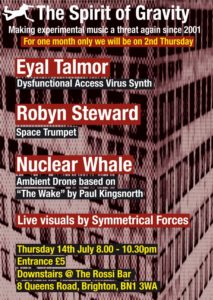
The Spirit of Gravity presents KIERAN MAHON / R. DYER / MARTIN CHICK
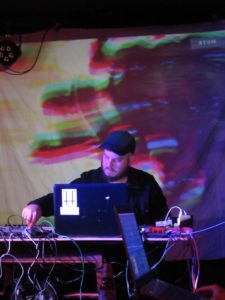
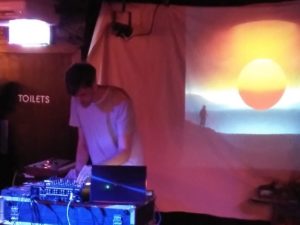
Starting the evening of people playing under their own real names we had Martin Chick. Last time I saw Martin play he was surrounded by a load of bulky kit including an old Korg, this he slimmed down to a Modular synth and another box, the inevitable clutter of wires ensuring it’s not too tidy. Starting with a bass pulse on the 8s with bell on the ones, he blends in some white noise snares, warbling tinnitus pitch tones marshalling in more drums. A bit of random pitching ushers in a more minimal section that ends up feeling like a fence post being replaced after a storm. Slowly, slowly, blocks of bass or noise or stem whistle are folded in and left to drift off. The sound empties out; cuts of drum in and out, beep tone, bass teased back, then again out. Those blocks of pink noise back, flexatone. A steam kettle in another room washes out everything, building to blistering boil and end.
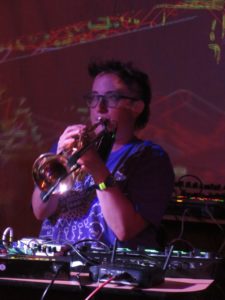
Finally we had R. Dyer to end the night. She started with what I suspect was an unplanned version of “Little Victories” with a new set of recorded good moments, they’re as funny as usual, the song as gloriously melancholy as usual, looped soprano sax lines weaving around each other over a low keyboard drone as Becca sings over the top. There’s a lot of new victories so we have a fairly extended outro involving washing up, Coventry, bells… other things. The second track starts with a strong keyboard bass line, organ notes, chimes, a couple of gently muted sax layers, vocals. Little raindrops is like an afternoon spent in the loft of your childhood home. “Canaries” was next, after a chat about the canary resuscitator, they were only retired in the late 80s. Who knew? It starts with a creepy creaking walking pace keyboard part, with some odd fx and singing from the canary’s perspective, an interlocking set of soprano layers, more singing finishing with the song of a toy canary. Starting with drum machine tambourine, unison soprano, I missed the name of the penultimate song. There is a sax solo in this one that really flies, lifts the spirits. “You don’t know what you’ve got till it’s gone”. For “King Alfred’s Cakes” Becca’s harp became detached from its contact mic, so she performs it acoustically, no electronics(!) but it’s wonderful, so we don’t mind. Voice and harp, do we need more description.