Category: SOG-BLOG

Before they be fires

May 2026
The Rossi Bar
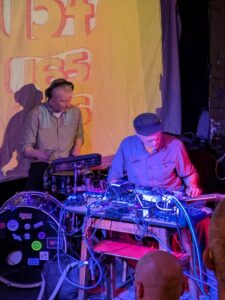
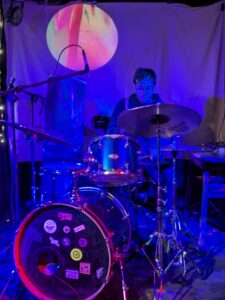
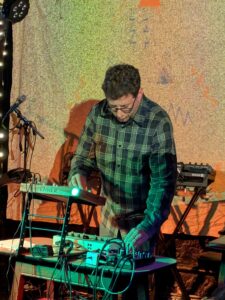
Shark Calmer start the evening. A duo: a drummer at the back and lap steel at the front. Both have other devices also. Drum pads, small boxes: synths, effects and such. They start with a regular tapping from somewhere, a following semi-erratic synth line, a clatter of drums, a burble, and from the distance a soaring lap steel line. A squelchier synth line. After a while the synth line morphs off, then everything pauses for a vocal line, then drops back in then drops out again as we mutate again. The drums come back with a thick slurping slide guitar, there’s some nice interaction back and forth between drums and guitar. A new bassline and new drums. Things are inserts between, under and over the guitar strings. The snare staggers in. faster. A feedback synth line springs up. The synth gets springy, and the drums drop out. We go all sputnik. The drummer gets a loop going on the electronic drums, we get some more lap steel, then the synth comes back in all weirdly detuned and squelchy. We get into some decay, the drums scatter, the guitar is saturated, the synths bubble gently with the LFO pinging it around.  The drummer has a synth Pan sound from the ark, which is rather nicely nostalgic. He constructs a new rhythm out of it, then starts chopping beats up, superfast, slow; uptight, relaxed; full, minimal, they end up on a choppy beat that skitters around. He drops the snare to get a timbale like sound. Frenetic. Then we’re back into a motoring bassline, shuffling drums and tinging bell. We get some feedback unto the synth and the drums skitter up some more. Energy levels rise, the lap steel gets some work around the upper frets going into some filter and vibrato – not unlike early Cabs, it all gets a bit noisy on the synths and we end in a squall of feedback and some rather nice bells, drum snap!
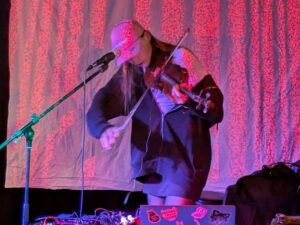

Asher Fynn starts with a nice burst of proper noise, which quickly gives way to effected violin spruced into a looper than gritted up with some more effects. Some loops become bass swoops and Asher starts the vocals, a brief history of recent anti trans legislation and it’s tragic outcomes. It’s a very angry start and very quickly ramps up into some very grainy hard noise and ends on a blast of feedback. The second song starts with a bumpy rumbling delay, Asher starts a viola line and a high melismatic vocal line, which is followed by a similarly sliding viola part, a return of that grainy noise and some spoken word. The third song starts with double tracked vocals on the backing track, the viola is stowed, Asher sings against the voices. It’s a very brief set with an interesting arc from grainy anger into still beauty, quite a feat to pull off.
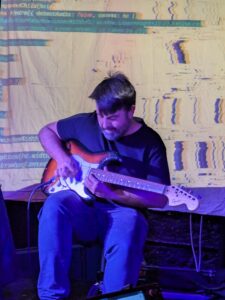

Sarram is our final act of the evening and our second act from Sardinia this year. He’s also another recombination guitar & synth player. It must be some kind of island adaptive evolution. He starts with lightly strummed high end notes that slowly fade up into our perception and into the effects chain. This picks out odd notes and resonances and slowly builds them into a massive swelling avalanche of sound augmented by neck bending and synthesiser blasts. Slowly everything starts to ebb away to some gentler thrumming and then to a 60s shimmer not un-similar to say the UK Kaleidoscope. You can still hear some vestigial synth buzz. The guitar starts to bounce off a lengthy delay, then we get into some filthy distortion and he bounces off into Vini Reilly labyrinthine delay. He drops the guitar and a voice is coaxed from one of the boxes on the table-top. We get creaking and rumbling; adding unease beneath it as the picking gives way to more distant sounds. He gets back into the distortion for a massive riff part that has almost no attack. Streams of washed out swirls drift around and it builds in intensity and volume that swells and then fades as he gets into a dramatic percussion solo on the synth. I start to worry about the wear and tear on the keyboard as he’s using his best Kung Fu moves on it. Children’s voices start to haunt us as the slightly squelchy onslaught continues. Then it’s into another more attacking riff, with thickening swamps of guitar pads murking up the backing. As its starts to fade away, we get a loop of brief dialogue about the nature of the music playing. He manages to coax some nice violin sounds out of his guitar and there’s some synth layers added.
And we fade out on a chiming synth sequence and the conversation chopped.
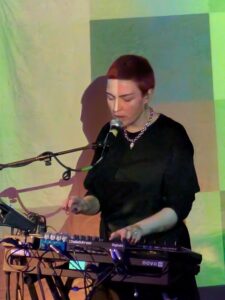
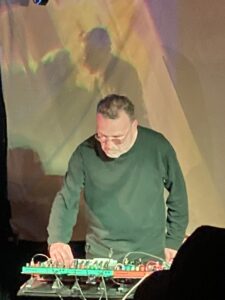
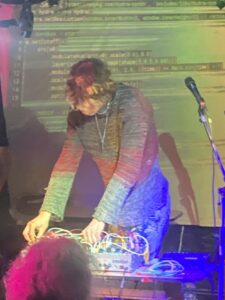
Inside the drains run all the time

April 2026
The Rossi Bar

Starting with Lorenzo Brilli purely because he has drums and it makes stage management easier. It’s not just acoustic drums, there’s a mic over the kit linked to a laptop and a contact mic’d long sheet of metal, which starts proceedings being gently beaten and processed. Then scraped with wire brushes, the processing migrates this into drones and crackling glitch, enhanced by rattling on the contact mike itself. The drones have a really nice sound, at once tonal and magnetic. He thickens the sound on the laptop, and then returns to the drum kit with a steady beater pattern on the ride. A voice wanders in and then everything halts with a crash.  A clacking from the laptop, then he’s on the full kit, a slightly elliptical beat, jazzy timing, little frills. The drones now wash in and out. It’s got a four to the floor bass drum, but everything else grooves around it really nicely, economical. The drones seem to be triggered by something. There’s an ending with a round the kit finish with a massive reverb off the end that turns into a wind tunnel and Lorenzo gets into some free improv drum fiddling, scraping cymbals with the end of the stick, and getting this into some creepy swirls. There’s some machinery and growling fading into some pretty detailed rattling. Then it’s another reset, a choral drone, occasional “Whey” against which he gets a surprisingly clacky floor tom rhythm. And handclaps. The next section starts with mutated throat singing (Bulgarian?), then it’s off into bells, whistles, hums and a steady brushes on snare beat. Jazz-ish. Plaintive. The drums stop and the voices carry on, thickening and warping. He does some fidgeting on the hi-hat that transforms into odd tonal swooshes.


Nanonic has a “non-keyboard” synth, a looper and a couple of effects pedals, here’s a nice synth in a wooden case with brass contacts instead of a keyboard. Nick false starts with a fat buzzing drone, modulating up into some pretty nasty frequencies, then back down into room rattling bass. He gets some pretty foul swoops into the looper and then gets to work on the synth again, with some feral scrapes and reedy foghorn drones. A shimmering delay gets to work white dogs bark near a major electrical plant. There is industrial clicking and a looped owl, the wind whistles over vibrating metal rods. Into this quiet eeriness we get buzzed by spaceships.  The wind whistles up for an end to the first piece. The second starts with a fast bass-y pulsing that you can feel flapping about in the speaker cabinets. There’s some manipulation of this up and down, in volume, tempo and tone. It gets a bit buzzy, a very different kind of pulsating UFO sound gets into the looper. The rinsed into a thin high looping whooshing, under which we get more buzzing bass pulses. And them pesky UFOs again. The whooshing thickens up and envelopes everything into a shrieking roar.


Drum and Lace is set up with 2 racks of hardware, Sofia completes the Italian sandwich for this evening, she starts with a firework crackle and field recordings of birds, straight in with wordless vocals and some synth pads. The crackling is joined rhythmically by some alarming short circuit clacks. We check for smoke, but it’s all planned. A nylon guitar arpeggio gently comes in, and some light string stabs. A rhythm proper starts under the track and we can see how the crackles and clacks all lock together. The second track swoops in with a speedy 2 note synth line, overlaid with 80s synth pop complementary parts, including a nice fat buzz followed by some warm emotional pads. Some slow vocals drift across the top underlying how frenetic the backing is. Things fall away under the vocals and one of the synth lines comes back fiercer and joined by some hard drums, another line returns – shifted slightly adding unease. Hissing hi-hats fade in to usher the end. A fast ticking hi-hat starts the next song with an intermittent kick and bass pulse. The pulse speeds up under vocals and a loping lead synth line takes us on into a hard techno section, then a drop. A slow kick brings back out under a changed vocal line, and back into the driving synth. The church bells toll, and a clockwork toy gives us the rhythm to start the next piece. A buzzing bass slurs between notes to give us the bassline, squeaks and strings layer in over it. The rhythm track layers up, bringing in a bassline as the vocals come in. There’s a nice melodic bass-y line that underpins the vocal that she does some buzzing filter work on as the song progresses. There’s a drop down to tapping and odd synth swells and birdsong before a new bassline comes in stronger and brassier to lift us into the final section, a blip on the offbeat, then the bassline transforms itself into a mutating percussive synth and the beat comes in strong and we’re briefly off on a tangent before everything is back and shifts around underneath it.


Immersive audio, visuals and intimate electronica

March 2026
The Rossi Bar

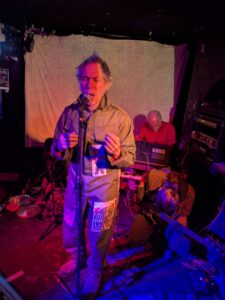
In the absence of our esteemed Geoff Cheesemaster, Dan Powell donned the wig and started the evening by leading a communal voice drone in memory of the inspirational and sadly missed Steve Gillitt (aka minimal impact).

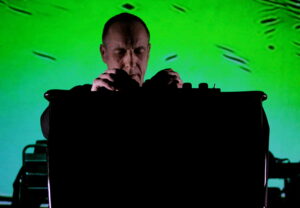
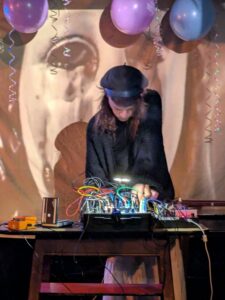
The drone theme continued as Andrew Greaves began his set with a mix of washes and conversational fragments using field recordings of Steve himself. Andrew’s performance continued with several pieces related to his recent “Headspace” release. Rhythmic synth figures underpinned some dark folkish melodies, with occasional interventions from some chit-chat looped samples. The shortest of minimalist pieces followed before things took a moodier turn; expansive abstraction, as a backdrop to the darkest of analogue improvisations. Andrew lifted the mood for the final stretch, as swooshing pulses and syncopated riffs gave way to some intense, eastern flavoured lead improvisations. His set concluded with something of an homage to the early days of electronic soundtrack music; a reedy organ, a faux Theremin and a chorus of wolf howls.

All of this against a backdrop of improvised and remarkably in sync visuals from Meljoann.


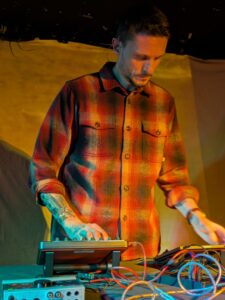
For his performance, Tam Lin combined modular synthesis and intimate vocalisations. His set developed gradually from a tapestry of spare, detailed analogue beeps and crackles. In time, intimate, half spoken vocals added the most human of touches. This piece grew organically, as the sound world widened into something more wide screen. This was a lovely, slow burn of a performance; drawing the audience into silence. Gentle, low fi figures followed, morphing into subtle, filtered sequencer washes. At the midway point Tam Lin introduced an arresting tick-tock beat and some mantra like vocalisations. His set finished with a beautifully jagged pitch-drop drum figure acting as back drop to an edgier song: taking a series of several sharp turns along the way. This piece concluded with a coda of intimate, layered analogue loveliness.


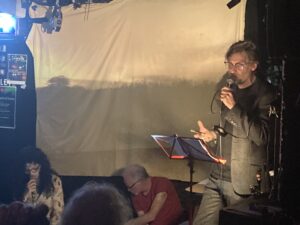
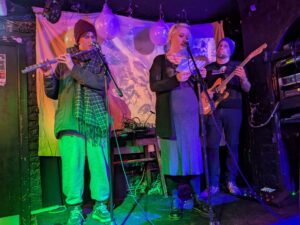
Oddfellows Casino provided a performance that for once justified that oft used description; immersive. The four participants packed the small stage; Al Strachan, Eliza Skelton and Emma Papper provided a sensitively layered electronic dialogue. Musically, it was conversational improv, but highly focussed and directed by both the visuals and the voice commentary. Meanwhile, David Bramwell’s commentary drew the audience into the past and almost forgotten world of the industrial north. The words and archival images detailed a lost steel industry, drowned villages and some occasionally inaccurate memories. Stories of real lives and brutal industry, strangely haunted by ancient mythology; stories including some vocal interventions from the voice of Alan Moore. The music, the words and the images cast something of a spell within the room; it was a very special performance. However, as Dan Powell was keen to remind us; next month will be even better!

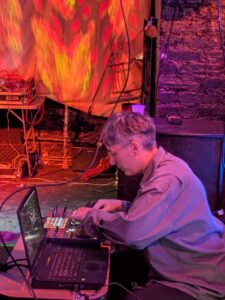
Thanks to Howard Spencer for the photos.


Steve ‘minimal impact’ Gillitt

We are extremely saddened to hear of the death this month of one of the founding members of the Spirit of Gravity Collective, Steve minimal impact Gillitt. In some ways he was the beating experimental heart of the Spirit of Gravity, with his single-minded search for the perfect noise, and keen willingness to collaborate, although if you played with him, he nearly always drowned you out with his volume. His 30 or so live performances in the first 15 years or so of our history were all memorably uncompromising, as were his appearances at related nights such as Wrong Music. He gave us the audience participation concept the electrocreche, although unfortunately we cannot fit this in at our current venue at the Rossi Bar, and his sardonic humour and rebellious attitude kept us honest through the years. His last release on our BandCamp label in 2018 was due to be part of a larger project, which we are very sad not to be able to experience, but he has left an archive of unreleased material from over the years, some of which we hope to be able to share with you in due course. We have lost a friend as well as a remarkable artist, so we will be marking Steve’s passing a number of times through our 25th Anniversary year, but this starts with Geoff Cheesemaster’s more comprehensive tribute on our website here: spiritofgravity.com/steve-minimal-impact-gillitt/ 
Everything happens without seeming to

February 2026
The Rossi Bar

Em— (Em-Dash, a typographic joke in case you’re interested) is the first act on this evening, stepping up at the last minute. June’s setup is a laptop and a flight case chock full of hardware. Starting with eerie long tones and a turned bass drum. And where the snare should be a metal rattle. A creeping bass line joins along with hi-hats and an actual rattle-y snare that slips around the beat. A little descending melody with hints of origins back in the radiophonic workshop chimes in, the beat slips out of kilter, and sounds start to mutate. Hell, everything starts to mutate into the slinky, stalking lurch of Tom Waits’ drunken uncle. A chopped voice is discernible, but not understandable. A chipper woodblock pattern trips in speeding things up, the drums distort behind it. June starts chopping around with the woodblocks, adding a squelch then dropping them out. This continues then the woodblocks seem to come back as a different squelch, the beat picks up, voices are being made to do alien things. Interlocking rhythms sourced from not your usual sounds wind away. Then drop into a new clap heavy lopsided beat. Punctuation provided by bells and laser hits. This is a solid groove, it seems to have one leg longer than the other but is insistent nonetheless. There is a sudden drop in tempo, space appears taking out most of the elements of the beat and then slowly replacing them with buzzing stammers, more squelchy bits, bass-y buzzes or booms. A shining melody line shimmers in over the top of the churning chaos. And so it continues, seemingly ill defined, mesmerising, shifting about, developing constantly. Rhythmically and sonically so inventive. Ending in a staccato frenzy of beats and short organ blips.


Next up was Rhubiqs with a setup of laptop, tablet and controller and a set that eschews the hyper-evolution of Em- in favour of apparent stasis. Starting with string synths slowly rotating in and out, these are joined with warbling tones. We sit there in this gently evolving wash of sound, there is a field recording of waves and the synths slow down to almost drone levels. The waves slowly die away and the tonal sounds fade in to replace the synths, it now feels like space music; earthrise over the moon, perhaps. Warm, though, and rich. There is birdsong and quiet rain. The string synths drift back in and a melodic refrain slowly emerges, then eventually thickens up into a nice rich drone. The details shift inside the drone and then it fades out to some mild glitching, to be replaced by looping more orchestral sounding strings. Slow piano notes drift over the top. There’s another hint of water in a field recorder trickling away in the background as we shift back into a new dronescape. A male choir indistinctly chants under the drone. A muted brass sound serenely provides another melodic intervention when the singing ends. Gently the stream fades up, and everything bar the melody drifts out of earshot. And then it’s just the melodic line. A beautiful calming filling to a fairly frenetic sandwich.


ChopChop, left to right, Ed (usually the drummer) is on the floor with lots of things, electronic and percussive, Al at the back, synth and cornet as usual, although he’s bought the MS1 out for a change, Eddie on bass and effects, and out front the irrepressible Xelis with vocals, trumpet and expressive dance. It’s a slightly different setup, shorter on monster groove than usual, but no less entertaining. It starts with Ed tapping a cymbal and Xelis gibbering and twitching. They build the intensity and a pulsing starts in. Ed starts a rhythm on the objects around him, the MS1 starts to warble, and Eddie starts some slow high bass notes, half a bassline. Xelis plays flurries on the trumpet. Everything drops down bar Xelis talking. Ed starts tapping out another rhythm, some processing makes then notes as well as hits, electronic stabbing noises envelop us. Xelis is dancing. It drops away again, to Xelis & squelches this time, then builds again. Ed is triggering occasional big noises. More space. “The butchers have gone mad”. Xelis is still in motion as everything around him stalls. The cornet comes in, bringing synth washes and the trumpet. Ed is at work on the electronics and Eddie furnishing occasional bass frills. Xelis throbs. Amazed. Al is back on the synth, Xelis takes up abstract singing again as we drift. Eddie has a bassline that slowly grabs our attention, and everything drops again. Xelis is guttural now, issuing commands, endless and contradictory. Someone starts up a synth rhythm. More synth lines join in. Xelis is twitching again. Cymbals come back in and a bassline starts, the percussion thickens, even though lacking a kick and the trumpet swirls. A synth is on a ramp in the background. The synth rhythm is relentless propelling Xelis into jerks. He is the last thing moving.


This was an actual birthday

January 2026
The Rossi Bar

Starting the year – a New Year following yet again another hottest year on record – we have a set by an augmented Remember Glaciers, with Jim with his laptop, but also electric guitar, and live memories narrated by Sophie Cowan and flute by Natty Purbrick. The synthesizer, as is the case with Remember Glaciers unfolds at a very slow rate, exceeding slow arpeggios and washes as befits the subject. The guitar and flute unfurl gently in the spaces around Sophie’s story of her visit to the Franz Josef Glacier on New Zealand’s south island. There is a melancholy, as you would expect from a series of performances based on the premise that we could be the last generation to remember glaciers. Jim and Natty alternate their responses to Sophie, each responding to the last’s playing. It’s really understated, and adds a nice level of detail on top of what is usually so stately in its flow. Sophie pauses speaking for a while and takes on some pre-recorded speech and starts to chop it using the Ableton controller, although its somewhat less frenzied than in others of Jim’s projects. While that is happening Jim and Natty play off each other, gently circling around and around.  Jim plays a little descending line that indicates closure and the piece ends with Jim’s usual request for more memories of glaciers.


Agnes Haus is next up, with a modular setup and their own flickering grey visuals. Starting with a reverb-y collapse into a church organ from a tidy modular setup. There is some creepy reverbed scrape from an untrue cassette player adding a warbling atmosphere, a scatter of harpsichord chimes give us a narrative frame. A slow regular staple double tap gives a rhythm and everything else strips away. The modular syncopates beeps slowly against that. A pinging piano line emerges from the mass of cables. This cycles away quite hypnotically for a while. Stephe picks up an electric mandolin (I believe) and holding it vertically bows in some harsh raspy drones and some blustery bursts of noise, which builds to a crescendo of squalls and racket – a nice buzzing bass-line underpinning it. It dies away to church organ drones again. Slowly against these we get bouncing little piano parts. The church organ fads and everything slows, there is a flapping fan, there’s a fade out while Stephe tries to find the source of the fan, and with a dramatic twist of a pot, kills it, to a burst of laughter from the audience.


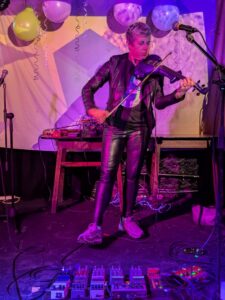
And to finish off the evening it’s our friend from The North Kent Coastal Electronauts, Sophie Sirota who had travelled 90 miles through rain and fog. She starts with a nicely melancholic electric viola line set against an insistent buzzing synth bass with a hard square LFO modulating it. After a while she loops part of the viola, and then gets to work against it adding texture, counter melodic lines. As the loops thicken the bassline seems to recede. There’s some whooshing and then she gets down on the floor to get working on the effects units before hitting us with a melodic line over the top and some metallic fuzz soloing. The second piece starts with a single plucked note that sets up a cascading backing synth line. She sings breathily into a deep reverb. Again it’s loading the looper, some tricky work with a delay pedal, some lovely rich tones, some more singing. Some more of that lovely viola line and back to the vocals. We finish off with a song that was written for an Intox Extravaganza, which may or may be called either “F**k it” or “These are the good days”. This one starts with a jabbing riff through loads of delay, some creaking bass bow-work, and some floating creepiness. Over this insistent backing track Sophie sings, and plays viola lines that to me invoked Tuxedomoon’s haunting “Ninotchka”. Full of Eastern European mystery. The song winds out in a savage deconstruction of the jabbing riff and a harsh warbling.


Yew hadda bee fare

December 2025
The Rossi Bar

I’ve been kinda putting off reviewing this one. We squeezed in four sets, two of which were performances by Henry Collins and Chase Coley that bookended the night. Both of these were very visual, multi-media and are going to be a bit tricky to describe….

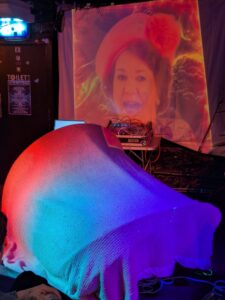
So we started the evening with Hyacinth Bucket and the magical testicle filled with thousands of bumble bees and the essence of creation. There is onstage a huge magical testicle, pink, a film starts with the back story and then Hyacinth Bucket herself appears onscreen and narrates the tale. Chase enacts the part of the shepherd and wanders around the room. And then approaches the magical testicle, and enters, skronking and plonking ensues. The testicle throbs. About ten minutes in The Bumble Bees are summoned. After a little longer angelic voices and a nearly naked Chase covered in magical symbols emerges from the testicle followed by Henry in a red dress coat and they gaze adoringly at the heavens.


Next up, with the tricky task of following that we had Meljoann set up at the side of the stage where she usually VJs. starting with a 4 to the floor kick, and quickly morphing through a variety of beats with a monster boinging kick sound, repetitive vocalisation stabs Meljoann goes for the extreme opposite of HBATMT.. Repetition, minimalism, looping back and forth, then dropping out down to a tiny pinging riff, and then she drops massive explosions onto it before bringing in some kind of truncated D’n’B drum track. Then a fidgeting bassline clambers all over that, before the rhythm track drop back to something possibly a little more techno, thickening up briefly into some kind of gurgly soup before a weird R’n’B drop takes into a pulverising one beat then something that I can only describe as doo-wop – which is a massive misdirection – reminiscent of the heady days when hardcore could go in all directions and often did. A fidgety drum track takes us out under some Prince-like synth drones to end.


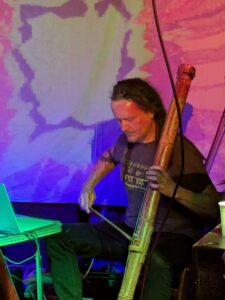
Then we had Luuma, a beast of a modular setup, with a laptop and some other devices. It starts with a thick buzzing drone and some feedback whistling. A wind of distortion threads through, there’s a hint of a scraping sound cycling away in the background, the drone starts to blister and bubble. The drone drops away into sustained balloon squeaking, its evil stuff, that starts to burble away until it drops into some kind of square wave LFO thing. That speeds and slows and gets into a bit of squelchy territory before morphing into a different more aeroplane-y drone. This continues for a while before upending in a squall of nasty electronic sounds that skitter about in a radiophonic manner before filtering down to a murky storm. Some giants start arguing over a didgeridoo in a room in the distance. Chris has a big wooden home-made drone instrument, this looks like a didge, but has a single string and some electronics. He rasps at it with a bow (in another life Chris is a talented cellist) setting up layers of harmonics and buzzing before getting into some free improv scratching. It feels like the giants are in torment now. Then he starts some sustained bowing getting thick heavy drones, before thinning it out into streamers of sustained tone based around harmonic standing waves on the string, then thickens this right up into a tasty storm to end.


And to end the night its Chase and Henry again, filling the stage with clutter – old CRT portable TV, tables, home-made bits and pieces, cassette player, cymbal, TV aerial… whatever. This was the dangerous end of the evening.

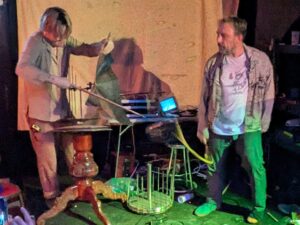
The set started with a fat drone, sourced by pressing an electric screwdriver chassis into the stage making it resonate. Chase enters the stage barefoot and starts getting white noise out of the radio. I can hear the wind coming from somewhere. Henry comes onstage also barefoot and opens a big pot of drawing pins and slowly sprinkles onto a contact miked piece of metal. Chase needs to move and realises that the stage is now very effectively booby-trapped. He picks up the waterphone and tiptoeing across the stage starts bowing it, wrenching high pitched drones, Henry starts scrumpling a cellophane octopus. Chase gets a reverb-y warbling undertone out of the waterphone. He gongs it as well. Henry seems to dismantle the octopus and gets the active noisy element out and continues with the crumpling as Chase gets back onto the radio. Henry gets into a fight with a Middle Eastern horn. Chase starts bowing a big square sheet of steel, while Henry starts rummaging drumsticks on and then around a large steel bin. This sheets more vigorous drumsticks flying around the stage, until the large steel tape measure comes out – Henry reels out about 5 feet of it and starts whipping it about the stage – it’s a nice white source of static bursts, but a little terrifying as zooms around the stage – especially when reversed and the tape holder starts clobbering the objects littering the stage. And getting further afield, Chase gets the screwdriver back to work. The tape measure holder is by now whirling around above the audience’s heads. Chase starts droning the metal bin building up to gong-like crescendos and Henry winds down into cymballic pings off something. Henry leads the audience into a slow plodding stamp that slowly fades out to end.